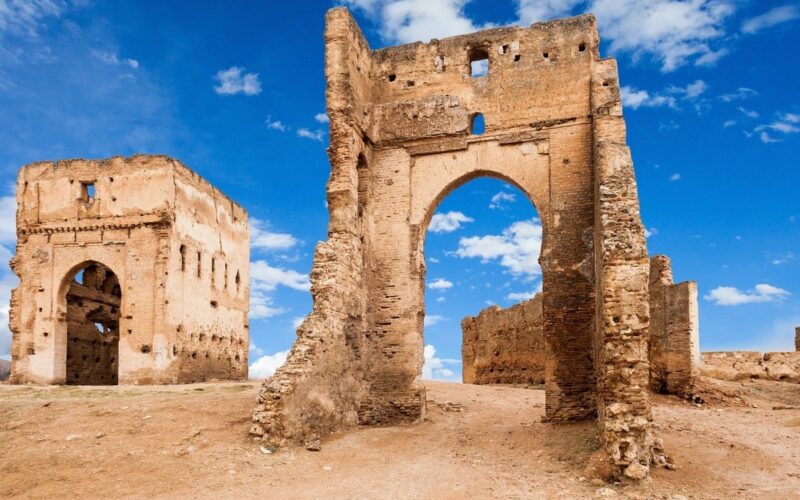

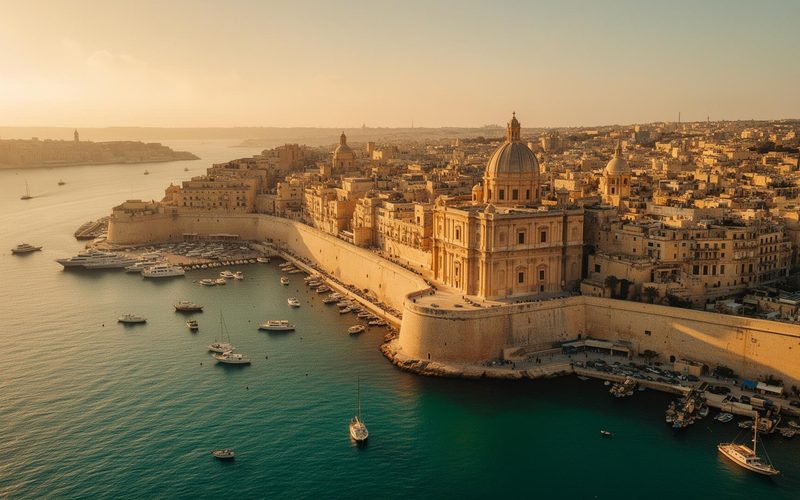
Landing in Malta felt less like arriving in another European country than descending into a turquoise, crystal-clear aquatic landscape anchored just off the European peninsula. Yet the names on the map read like a familiar geography from back home. On the streets, people spoke a language that sounded distinctly North African—as if Morocco had somehow laid down its historical rivalries, quieted its post-colonial anxieties, and distilled its shared linguistic roots into a single island nation. Malta sounded like a parallel version of North Africa: orderly, preserved, and echoing an era when Moroccan empires held both shores of the Mediterranean in a single, confident palm—a connection deeply reflected in the distinctive character of Maltese architecture.
Table of Contents
I. Echoes of the Kasbah and the Spirit of the Ribat
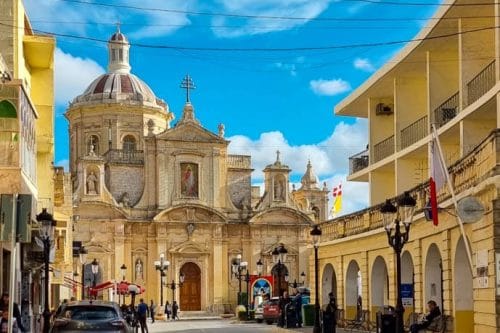
If any European or northern traveler heard me say it, they might laugh at the comparison. Yet standing in Malta’s Rabat, the resonance was unmistakable. Malta’s Rabat does not resemble the grand, modern national capital of Morocco, but rather the quiet, sun-drenched approach to an old Kasbah—honey-colored clay, warm stone walls, chic sidewalk cafés, and pizzerias perched above a sea so brilliant it feels as though the town is floating in history, suspended in time. It felt like a landscape left behind by Marrakesh or the southern oasis.
At first, I thought the similarity was a coincidence. History proved otherwise. Following the Islamic conquest of Malta in the ninth century, the islands were bound to the administrative and cultural orbit of the Aghlabid dynasty in Ifriqiya, modern-day Tunisia, before falling under the sphere of the Fatimids. This was an era when the Mediterranean was not a barrier dividing faiths, but a thriving liquid continent. Settlers, scholars, and sailors from North Africa transformed the archipelago’s agriculture, introduced intricate underground irrigation systems modeled on North African techniques, rebuilt ancient fortifications, and established the rich Sicilian-Arabic linguistic foundation from which modern Maltese would eventually evolve.
For over two centuries, Malta belonged intimately to the same maritime sanctuary that connected Kairouan, Tunis, Palermo, Cordoba, and the ports of Morocco. Many of today’s Maltese place names survived from that golden maritime era, and among them, Rabat stands as a profound testament. The word carries a meaning far deeper than a mere suburb sitting outside Mdina’s grand fortified gates. In Morocco, a ribat historically referred to a fortified outpost on the frontier, but spiritually, it was a sacred retreat. During the rise of the Almoravid dynasty—Al-Murābiṭūn, literally “those who bind themselves to God”—the ribat was both a stronghold against external threats and a sanctuary for spiritual discipline, rigorous scholarship, and communal devotion. The Almoravids emerged from the desert expanses of present-day Morocco and Mauritania in the eleventh century, transforming their ribats into centers where spiritual refinement and political vision were forged together. To be a Murābiṭ was never simply to hold a physical border; it was an act of remaining spiritually grounded.
This spirit of the murābiṭ also lives in Morocco’s long traditions of spiritual sanctuary, particularly through the lens of women’s devotion. As the writer and sociologist Fatima Mernissi observed in her writings on Moroccan women and saint sanctuaries, the shrine of the marabout—a word directly derived from murābiṭ—has historically offered women a sacred space of agency, solace, and inner transformation. For centuries, women turned to female saints and marabouts not merely for prayer, but to enter a state of refuge where emotional and spiritual healing could unfold undisturbed. The sanctuary functioned as an intimate ribat for the soul, a place where boundaries dissolved and grace took root. To walk through Malta’s Rabat with this memory is to realize that the spirit of the murābiṭ was never solely military or institutional; it was a deeply human search for sanctuary, quiet strength, and spiritual elevation that traveled across stone and sea alike.
Morocco has always maintained an intimate relationship between architecture and spirituality. Its saints, scholars, and Sufi masters rarely separated urban design from the inner life, viewing every arch, courtyard, and alley as an extension of the soul’s discipline. Walking through Malta, I found myself wondering whether architecture itself could preserve memory. Stone certainly can. Language certainly does. Perhaps cities can pray long after those who built them have disappeared.
Leaving Morocco is rarely a neutral act. You depart with a heavy heart and a quiet, unspoken prayer for something better—a dream of what your country could be if its potential were fully realized. Yet the moment you arrive in cold, rain-soaked foreign cities, an unexplainable longing takes hold. In those distant places, a warm dish of Pastilla becomes your only tangible anchor back to warmth, family, and light.
II. Architecture, Memory, and the Heat of the Mediterranean
Malta bridges that emotional gap in unexpected ways. Known for its fierce sea winds and relentless sun, it holds a culture that feels Italian in its cadence, yet grounded in a language unmistakably related to Darija. One afternoon, I walked down the road in Ħal Safi toward the Church of St. Paul, feeling the intense heat of 40°C and heavy humidity under a blazing sun that turned the day into an inferno—what you might call “Hell o’clock,” where you could sunbathe at any hour. Passing a quiet neighborhood winery, I watched masons restoring a dusty limestone building in the searing heat.
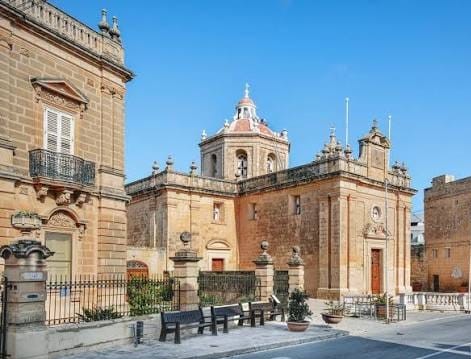
As I passed, one looked up and offered a warm, smiling, “Ċao, sabiħa.” Beautiful. The word struck me immediately, recognizing the root instantly: sabiħa—carrying the meaning of beauty, radiance, and morning brightness—another fragment quietly living inside the heart of Europe. I thought, Really, in this melting sun, you think so!
The village name itself fascinated me even more. Linguistically, historians explain that the Maltese prefix Ħal evolved from the Arabic raħal, meaning a settlement or small waypoint. Yet for someone familiar with Islamic mysticism, another association naturally appears. In Sufism, ḥāl describes a fleeting spiritual state bestowed upon the seeker during moments of profound divine awareness—a temporary elevation beyond ordinary consciousness. Combined with Safi, meaning pure or clear, the village almost poetically suggests a clear spiritual state. Perhaps linguists would reject that reading as mere coincidence, but literature does not have to.Sometimes meanings coexist, and places carry emotional truths alongside historical ones. Walking through Ħal Safi, surrounded by quiet streets and pale stone walls shimmering beneath the summer sun, I found myself thinking less about technical etymology than about atmosphere and memory.
Everywhere in Malta, architecture continued to whisper of Morocco. The enclosed wooden balconies (gallarija) are reminiscent of North African lattice screens, alongside the honey-colored limestone, the cool interior courtyards hidden behind modest, unpretentious façades, and the narrow, winding alleyways designed to break the desert wind and trap the sea breezes.
III. A Living Empire of Civilizations: Valletta to the Sea
From Ħal Safi, the bus winds northward toward Floriana and Valletta. Entering Valletta often felt deceptive. Valletta’s homes look modest and compact from their heavy reddish doors, but step inside and the high-ceilinged interiors carry the familiar scent of cool stone, coastal humidity, and history. Looking down through the narrow alleys—the Maltese still call them Zqaq, directly from the Arabic Zuqaq—you see a vibrant tapestry of street life: Middle Eastern food stalls and pizza joints nestled along steep stone staircases, opening suddenly to breathtaking vistas of Grand Harbour where cruise ships sit bathed in sunlight and British tourists lounge by pools at any time of the day.
In the early morning, Valletta smells of butter, toasted flour, and woodsmoke from local bakeries. Following the aroma down a cobblestone side street brings you to an open-air kiosk where traditional Maltese bread (il-ftira) comes out of massive stone ovens—a crusty, golden delight for anyone deciding what to order.
By evening, the city slows to a gentle murmur. Valletta settles into the white noise of the surrounding sea, and the stone staircases transform into open-air lounges where visitors and locals dine and wine under the stars. Malta feels perpetually transient—an island where people are always arriving or preparing to depart, taking relationships lightly but holding peace and retirement dear. Yet it is impossible not to fall for its quiet villas overlooking the water, built from yellow globigerina limestone that keeps them cool in the summer heat and sheltered against winter gales, reminding you of everything you left behind and the reasons why you traveled so far.
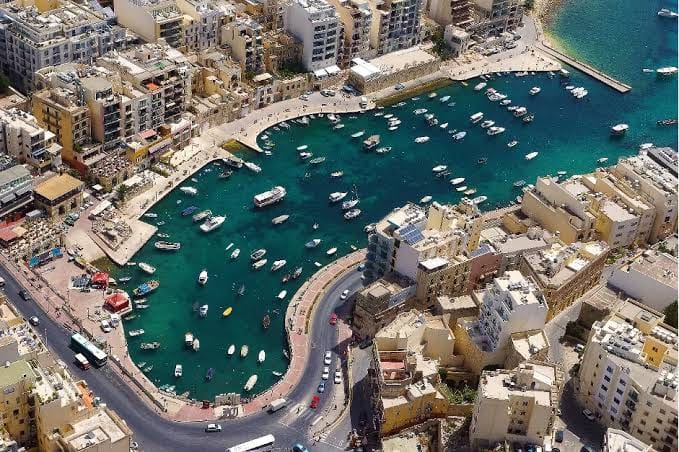
Moving along the coastline toward St. Julian’s and Ta’ Xbiex, the atmosphere shifts into modern luxury and coastal glamour. Villas and penthouses line the waterfront, inviting you to trade quiet solitude for the hedonistic trinity of sun, sea, and deep, restful sleep. St. Julian’s carries a carefree, international energy—modern towers, hotels, bustling casinos, and high-rise developments looking down on the bay. Low tax regimes and a booming financial sector have turned the island into a magnet for European business, giving it the feel of a self-contained modern maritime principality where the island feels like a living empire.
Further inland lies Mosta, famous for the Rotunda—the grand church whose dome famously survived a direct bomb hit in World War II when the munition failed to explode. In Mosta, local life turns on intense community traditions. Religious festivals regularly close the streets, while the sky erupts with the island’s legendary pyrotechnic craft. Malta is a place where church bells ring and the thunder of experimental fireworks hits the atmosphere simultaneously—a dramatic soundtrack to an island that has served as the cinematic backdrop for epic historical dramas and television series like Game of Thrones.
The more time I spent on the island, the more one realization returned: Malta is not Morocco, nor should it ever be reduced to it. Its identity belongs entirely to itself, uniquely shaped by an extraordinary succession of civilizations—Phoenicians, Romans, Byzantines, Arabs, Normans, the Knights of Saint John, the French, and the British. Yet among those heavy layers, the North African chapter remains one of its deepest foundations. Its language, agricultural systems, urban planning, architectural vocabulary, and place names continue carrying unmistakable echoes from across the sea.
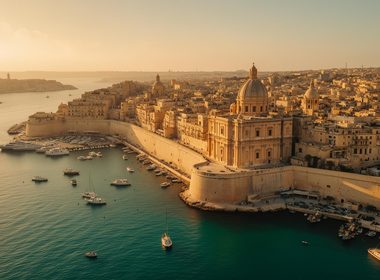
For Moroccans, recognizing those echoes is not about claiming ownership over another nation’s heritage. It is about recognizing how deeply connected the Mediterranean once was before modern nation-states and rigid borders taught us to think in divisions. Standing along Valletta’s harbour at sunset, watching golden light dissolve into turquoise water, the distance between Morocco and Malta suddenly felt much smaller than any map suggested. The Mediterranean has never truly separated civilizations; it has carried them, acting as a great liquid bridge across the centuries.
Perhaps home is not only the place where we are born. Perhaps it is also the place where our language unexpectedly survives, where familiar stones greet unfamiliar footsteps, and where history quietly reminds us that human cultures are never confined by borders. Sometimes, without realizing it, we spend our lives searching for fragments of ourselves in distant places. And sometimes, those fragments are waiting patiently on a yellow island in the middle of the sea.