
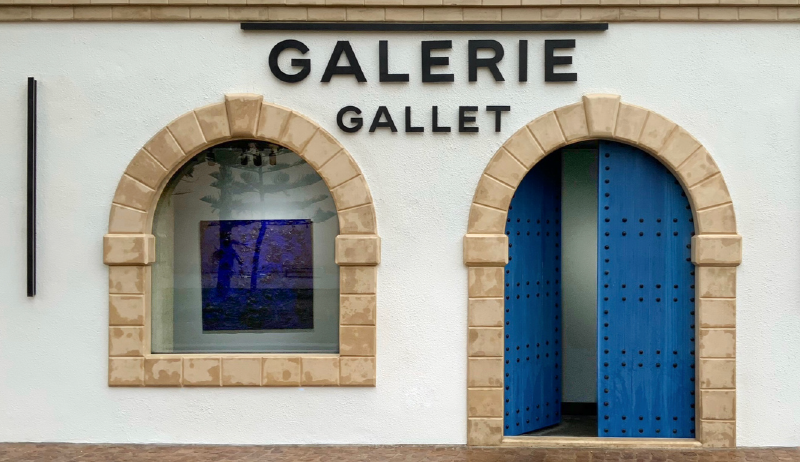
At the entrance of Essaouira’s medina, a gallery called GALLET Gallery “Galerie Gallet” takes shape as a direct response to the works it contains. Conceived by Jérôme Gallet as both an exhibition space and a structural extension of his practice, the gallery does not operate as a neutral container. Instead, it is built around weight, surface, and mineral density. Architecture here follows material logic.
From the outset, the space establishes its priorities. Walls are clear and restrained, circulation is deliberate, and light is controlled rather than theatrical. This architectural sobriety allows the works to assert themselves fully, works that behave less like images and more like constructed surfaces. The gallery becomes a site where painting approaches architecture, and where material presence determines spatial decisions.
Table of Contents
Works That Occupy Space
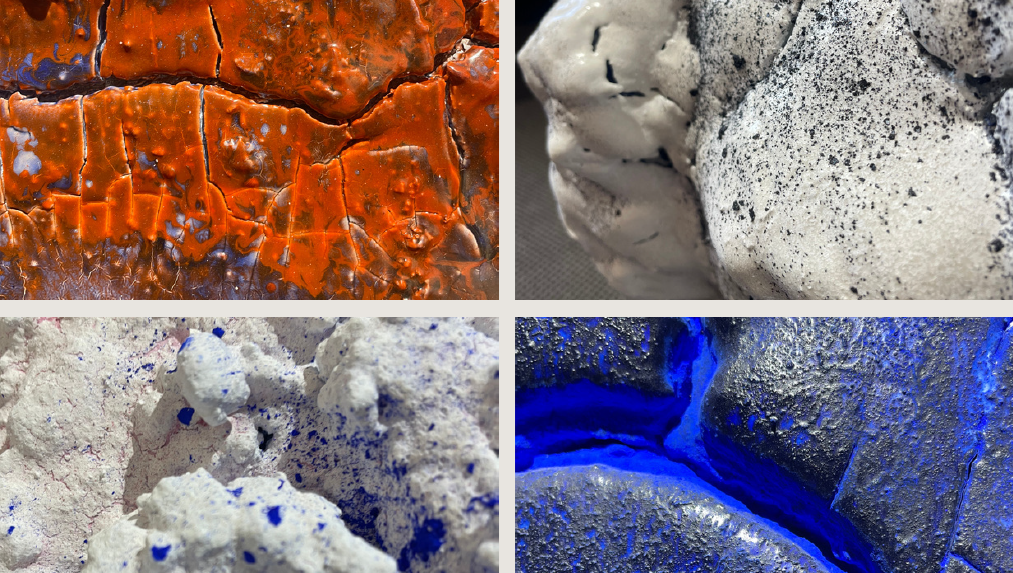
The artworks presented are composed of mineral powders and pigments assembled into thick, dense layers. Their physicality is immediate. These are not flat planes, but surfaces that accumulate, compress, and fracture. Texture is not an effect; it is the result of construction.
Large horizontal formats, some extending to 300 × 100 cm, stretch across the walls like compressed landscapes or geological cuts. Their scale demands distance. Square formats, such as 200 × 200 cm or 150 × 150 cm, introduce a more compact and frontal presence, anchoring the space visually. Each format establishes a distinct rhythm within the gallery, guiding movement and perception.
One work in particular, Khol, stands out through both its title and its material intensity. Referencing a substance deeply rooted in Moroccan culture, the name points toward depth, darkness, and density. Installed within the gallery, Khol absorbs light rather than reflecting it. Its surface appears compact and weighted, revealing subtle variations only through proximity. The work reads almost like a fragment of a wall: an object that belongs as much to architecture as to painting.
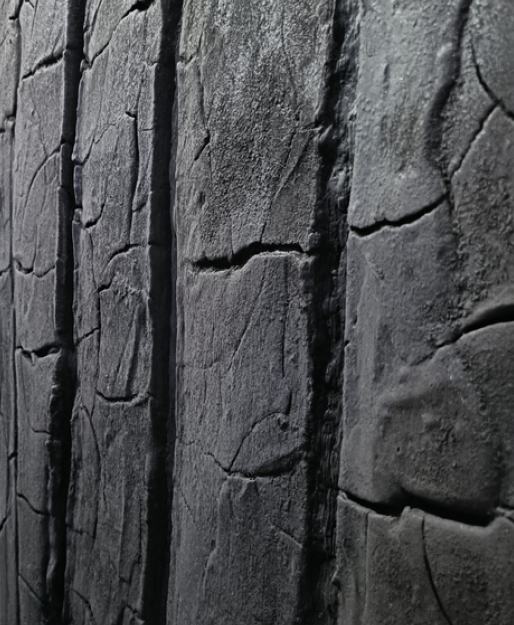
Other works, presented in formats such as 250 × 100 cm, 200 × 150 cm, or 160 × 80 cm, extend this mineral language. Lighter pigments interact with denser zones, creating layered surfaces where depth unfolds slowly. There is no central focal point; instead, the eye moves laterally, following strata and irregularities. The experience is spatial rather than narrative.
The Gallery as Structural Support
The gallery’s architecture responds precisely to these demands. Walls act as supports rather than backdrops. Hanging systems acknowledge the physical weight of the works, making gravity an active component of the exhibition. Nothing feels excessive or imposed; the space is calibrated to hold, not to compete.
Circulation is designed to encourage movement around the works. Frontal viewing gives way to oblique angles, allowing reliefs and textures to emerge progressively. This sequencing transforms the act of viewing into a spatial experience, closer to moving through a built environment than to reading an image.
Light is used sparingly and with intention. Rather than dramatising the works, it grazes their surfaces, revealing mineral reliefs and subtle shadows. As daylight shifts, the perception of depth changes. A surface seen in the morning does not register the same way later in the day, reinforcing the sense that these works are active material fields rather than static compositions.
Scale, Detail, and Rhythm
Smaller formats, such as 35 × 35 cm, punctuate the gallery rhythmically. These compact works function almost like material samples, condensed fragments of larger constructions. Their placement slows the pace of the visit and invites close inspection, reinforcing the importance of scale as a spatial tool.
Together, the works establish a dialogue between monumentality and intimacy. Large surfaces hold the room, while smaller pieces draw the viewer inward. This balance contributes to the gallery’s architectural coherence, where each element plays a structural role.
Anchored in Essaouira
Situated within a city defined by stone ramparts, weathered walls, and mineral textures shaped by wind and salt, the gallery feels anchored rather than inserted. Jérôme Gallet’s decision to establish his space here reinforces a shared material sensibility. The connection between the works and Essaouira is not illustrative but structural: density, endurance, and surface link the interior space to the city beyond its walls.
This Gallery proposes a model in which exhibition space is built around the physical intelligence of the work. Here, paintings are not simply displayed; they are housed, supported, and allowed to occupy space fully. The result is an environment where surface becomes structure, and where looking is inseparable from movement.
For those curious about the intersection of material, space, and perception, visiting the gallery offers an experience that cannot be replicated digitally. Architects, designers, and anyone attuned to the logic of construction will find inspiration in how walls, light, and surface are orchestrated to serve the work rather than overshadow it. Walking through the gallery is a lesson in restraint, precision, and spatial empathy, an opportunity to see how architecture can be both a support and a partner to artistic expression. Each visit invites careful observation, encouraging visitors to move, linger, and discover the nuanced dialogue between material presence and human scale. The gallery is located at Avenue Oqba Ibn Nafi, 44000 Essaouira, Morocco, making it an accessible destination for those exploring the artistic city.
Here you have More information about the artist and the Gallery: