
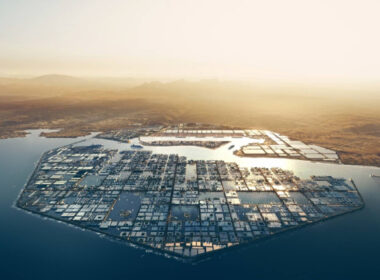

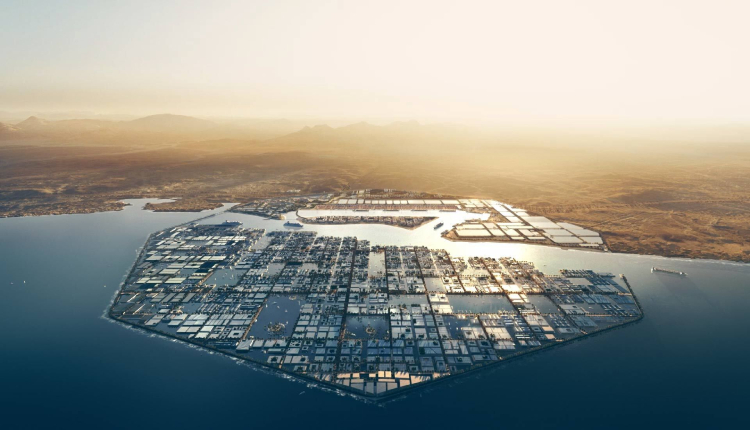
In the deserts of northwestern Saudi Arabia, NEOM was never just a city. It was conceived as an architectural manifesto, an attempt to compress the future into a single, continuous line. A place where infrastructure would disappear, where mobility would be frictionless, and where urban life would be fully re-engineered through technology.
But today, that manifesto is being rewritten.
Recent cancellations of major construction contracts across NEOM, particularly those tied to its most emblematic component, The Line, have sparked a wave of speculation. Are these setbacks the result of global instability, rising construction costs, and geopolitical uncertainty? Or do they reveal something more fundamental?
The answer lies somewhere less convenient: NEOM is not being undone by the world, it is being corrected by reality.
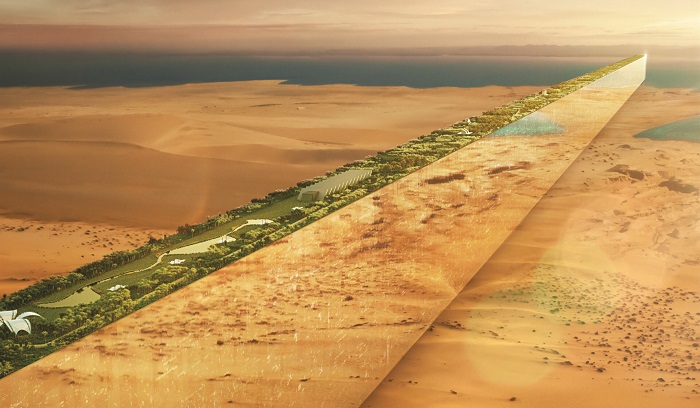
Table of Contents
The Narrative of External Crisis
It is tempting to attribute NEOM’s recalibration to external forces. The global construction industry has been under pressure: material costs have surged, supply chains remain fragile, and geopolitical tensions continue to reshape investment flows. Mega-projects, by their nature, amplify these risks.
Within this framework, the cancellation of contracts appears logical, almost inevitable. A project of NEOM’s scale, dependent on vast resources and long-term stability, would naturally respond to such volatility.
But this explanation, while partially true, is ultimately insufficient.
Because it suggests that, under better global conditions, NEOM would have unfolded exactly as planned.
That assumption is difficult to defend.
An Architecture Beyond Its Own Limits
At its core, NEOM, and especially The Line, proposed something unprecedented: a 170-kilometre linear city housing millions, structured as a continuous megastructure in the desert.
This is not simply an ambitious project. It is a radical departure from the accumulated knowledge of urbanism.
Cities, historically, evolve through layers, incremental growth, adaptation, and decentralization. NEOM, by contrast, attempts total design: a fully predetermined system where infrastructure, mobility, and habitation are compressed into a singular form.
The implications are profound:
- Infrastructure does not scale linearly at this magnitude, it becomes exponentially complex.
- Human behavior resists rigid spatial systems, particularly those without precedent.
- Environmental conditions, heat, sand, reflectivity, challenge even the most advanced materials and engineering strategies.
None of these issues are new. They were present at the moment NEOM was conceived.
What has changed is not the project, but our willingness to acknowledge its limits.
The Economics of Imagination
Beyond engineering, there is a more decisive constraint: economic viability.
Mega-projects rely not only on technical feasibility but on long-term justification, on their ability to generate value proportional to their cost. In NEOM’s case, escalating budgets have intensified this question.
At what point does a vision cease to be an investment and become a liability?
The recent contract cancellations suggest that this threshold is being actively negotiated. What was once presented as a seamless, inevitable future is now subject to revision, reduction, and strategic retreat.
From Utopia to Adjustment
What we are witnessing is not the collapse of NEOM, but its transformation.
The project is shifting, from a totalizing urban vision toward something more fragmented, more pragmatic, and perhaps more conventional. Certain components may survive, others will be scaled down, and some may disappear entirely.
This process is not unique. It reflects a familiar trajectory in architecture:
- Vision precedes feasibility
- Scale amplifies contradiction
- Reality enforces adaptation
NEOM simply magnifies this cycle to an unprecedented degree.
A More Honest Reading
To frame NEOM’s current state as the product of global instability is to misunderstand its significance.
The world did not derail NEOM.
NEOM revealed the limits of its own premise.
The rising costs, the cancelled contracts, the shifting priorities, these are not anomalies. They are symptoms of a deeper misalignment between speculative architecture and material reality.
Architecture After the Spectacle
NEOM remains one of the most important architectural experiments of our time, not because it will be built as imagined, but because it exposes the boundaries of what can be imagined at all.
Its true legacy may not be a linear city stretching across the desert, but a critical moment in architectural thinking: a reminder that vision, no matter how advanced, must ultimately negotiate with physics, economics, and human behavior.
Or, more simply:
NEOM is not collapsing because the world changed, it is being reshaped because reality has caught up with ambition.
Dive into our other blogs and follow the transformations shaping the MENA architectural projects scene.