




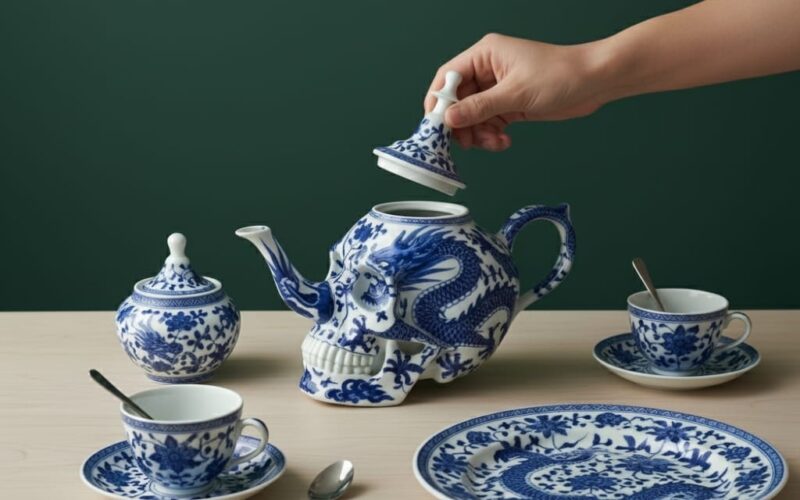
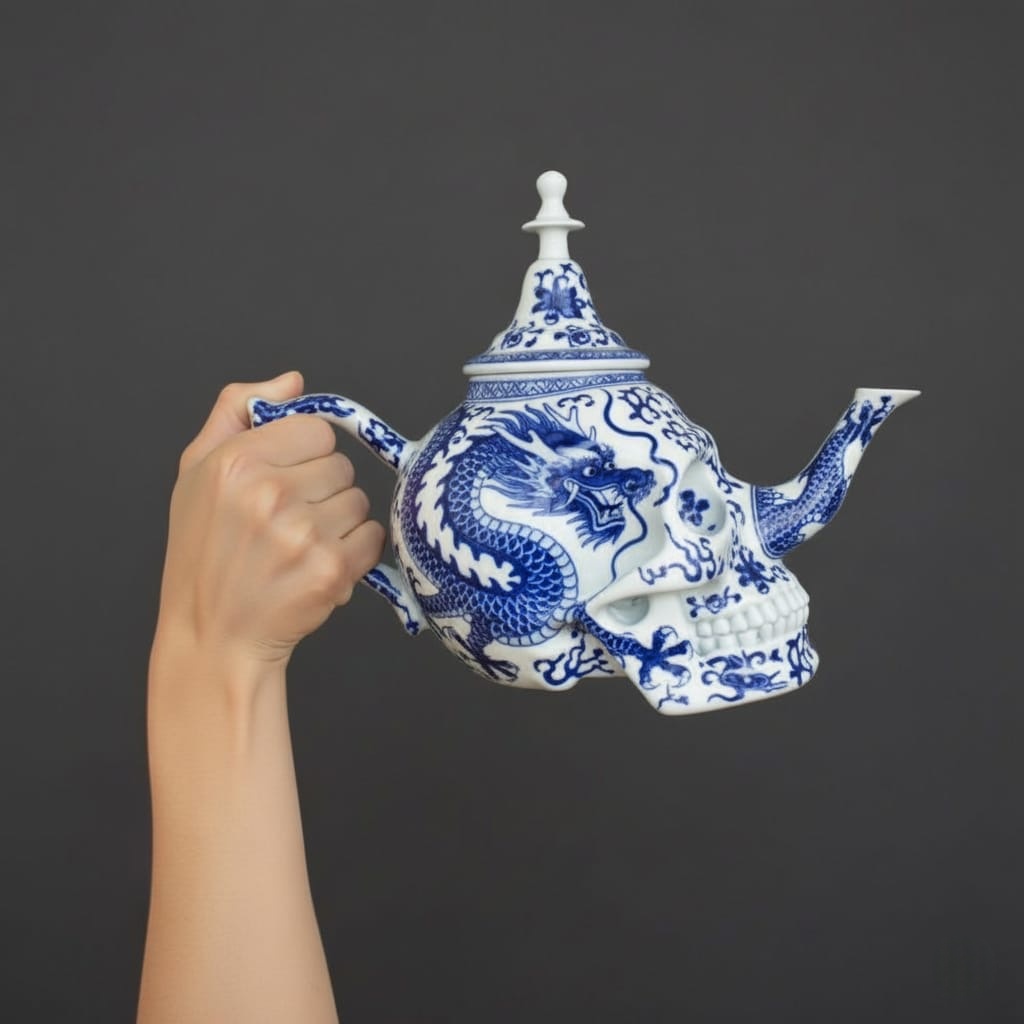
In a world where contemporary design often tries to break free from the past, Momento Mori by Mahdi Naim proposes the opposite: a return to cultural heritage through a new lens, one that acknowledges the rhythms of modern life without abandoning the weight, memory, and beauty of tradition. At first glance, this limited-edition teapot captivates because of its unusual form: a skull made of French porcelain, glazed with cobalt-blue motifs reminiscent of the Ming dynasty. But behind the striking visual stands something deeper, a cross-cultural story that bridges Moroccan tradition, European philosophy, and Asian craftsmanship.
Table of Contents
This project reimagines a familiar object of daily life: the Moroccan teapot, an icon in households and cafés, a symbol of hospitality, conviviality, and shared time. In Memento Mori, the teapot becomes not just a functional object, but a reminder, a meditation on ephemerality, on the fleeting nature of daily rituals that we often take for granted. According to the project description, the design fuses “the heritage of the Moroccan tea ritual with European vanitas… adopting the symbolic shape of a skull,” transforming an everyday gesture into a poetic reflection on impermanence.

Tradition Reframed for the Present
What makes this piece resonate with contemporary audiences is its ability to speak to our moment. In a time dominated by fast consumption, accelerated digital exchanges, and a constant sense of urgency, Memento Mori invites slowness. It asks us to hold a warm object between our hands and consider the layers of culture embedded in it.
In Yaz Magazine’s tradition of spotlighting Mediterranean and diasporic narratives, the piece stands as a perfect embodiment of how heritage can be reactivated, not preserved under glass. By reshaping the teapot into a skull, the designer introduces the European artistic concept of vanitas, a genre of still-life painting popular in the 16th and 17th centuries, meant to remind viewers that beauty and material goods are transient. The skull is a classic symbol of the genre, and here it becomes a vessel for tea: a drink tied to community, ceremony, and the simple joys of life.
The juxtaposition is deliberate and thought-provoking. If the Moroccan teapot often embodies warmth and connection, the skull stands for the inevitability of time. Together, they bridge two ways of understanding the world: one rooted in living traditions, the other in philosophical contemplation.
A Dialogue Between Craft Traditions
One of the remarkable dimensions of Memento Mori lies in its material and decorative choices. Crafted from French porcelain and adorned with cobalt-blue motifs inspired by Ming porcelain, the object becomes a meeting point between continents. It represents how “dragons and clouds intertwine gracefully,” echoing symbols of power and refinement in Chinese artistic heritage.
This layering of references is not simply decorative; it reflects a globalised world in which cultural borders are porous, where influences intermingle naturally. The French ceramic savoir-faire, the Moroccan ritual of tea, the Asian decorative vocabulary, and the European philosophical tradition coexist harmoniously in a single, intimate object.
Such hybridity mirrors how many of us live today: navigating multiple identities, traditions, and histories at once. The teapot becomes a metaphor for this contemporary condition: fluid, multifaceted, and enriched by exchange.
A Contemporary Ritual for Daily Life
Despite its artistic complexity, Memento Mori is not purely conceptual. It remains a functional teapot, meant to be filled, poured, and used. This is what makes it profoundly contemporary. It does not ask to be admired from afar; instead, it quietly transforms a daily ritual into a mindful encounter.
Every time tea is prepared with it, the user is reminded of the value of time, its passing, but also its offering: moments shared, conversations started, pauses taken. In this way, the piece echoes a broader cultural movement toward intentional living. It resonates with people seeking to reconnect with meaning, craft, and slowness in their day-to-day routines.
A Vision for Future Heritage
Ultimately, Memento Mori offers a model for how designers today can approach cultural heritage: not as something fixed or nostalgic, but as a fertile ground for reinterpretation. By merging Moroccan tradition, European symbolism, and Asian craftsmanship, the project embodies a new form of contemporary Mediterranean identity, global in its influences yet grounded in ritual and memory. Mahdi Naim beautifully describes this ethos, calling the work “a contemporary vision of Mediterranean and global heritage,” a piece that transforms a simple gesture—preparing tea—into a moment of poetic reflection.
In a world constantly pulling us forward, Memento Mori gently turns our gaze back, not to stay in the past, but to understand the richness it brings to the present.